
HOW ACCURATE IS PLASMA CUTTING?
November 10th, 2025
Handheld Plasma Cutting
Handheld torches are indispensable for field repairs and scrap processing, but they are no longer considered a viable solution for precision fabrication. Even a master fabricator with decades of experience generally achieves a tolerance of approximately 1/16". In a 2026 production environment, this margin of error is often too high for parts requiring seamless assembly or automated welding.
CNC Plasma Precision Tiers
The accuracy of a CNC system is determined by the synergy between the motion controller, the plasma power source (such as the Hypertherm XPR series), and the mechanical drive system.
Entry Level and Light Industrial
Modern entry level tables typically maintain a tolerance of ±0.03". Light industrial machines, featuring more robust gantry designs, improve this to a range of 0.015" to 0.025". These are ideal for general part production where extreme high definition is not the primary requirement.
Heavy Industrial and High Definition
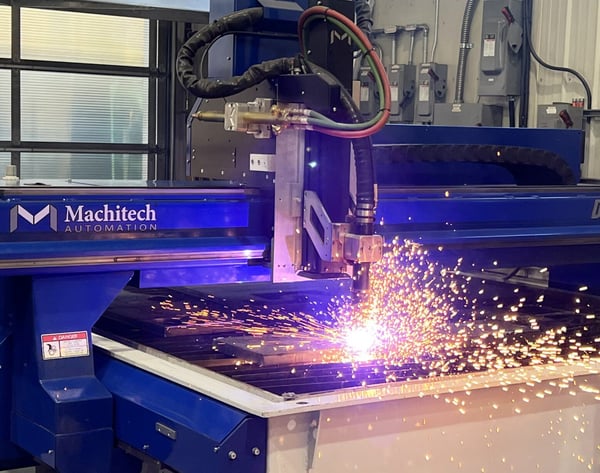
Heavy duty systems like the Machitech Diamond Cut or Platinum Cut are engineered for 24/7 high volume production. These machines utilize precision ground linear guides and helical rack and pinion drives to achieve tolerances 0.01 and 0.02". The use of True Hole and Bevel technologies has further refined these results by automatically adjusting gas flow and torch angle during the cut.
The Role of Automated Torch Height Control (THC)
Accuracy on the X and Y axes is irrelevant if the Z axis (vertical) is not perfectly controlled. Machitech systems utilize advanced sampled voltage THC.
- Dynamic Adaptation: As thin materials like aluminum or stainless steel heat up, they tend to "pop" or bow. The THC monitors the arc voltage thousands of times per second, adjusting the torch height instantly to maintain a consistent distance from the plate.
- Angular Consistency: Maintaining the correct standoff height is the only way to ensure a consistent kerf width. Without THC, the torch might move too close or too far, resulting in significant "top dross" or "bottom dross" and inconsistent part dimensions.
Understanding the Plasma Gas Swirl and Bevel
A common misconception is that a plasma cut should be perfectly vertical like a laser cut. However, because plasma gas is "swirled" to stabilize the arc, one side of the cut will always have a slight bevel.
- High Definition Improvement: High definition torches have refined this swirl to the point where the bevel is nearly imperceptible on materials thinner than 1/8".
- The "Good Side": Because of the clockwise swirl of the gas, the right hand side of the cut (relative to the torch's forward direction) will always be the squarest. Machitech software automatically accounts for this by ensuring the torch travels in the correct direction to place the "square" edge on the finished part and the "beveled" edge on the scrap.