
IS YOUR SHOP A SAFETY LIABILITY? LEARN ABOUT CUTTING EQUIPMENT SAFETY
December 22nd, 2025
Safety Standards for Automated Cutting Systems
In the North American industrial sector, safety is a non-negotiable priority. Top manufacturers of automated cutting equipment do not view safety as an add-on; they treat it as a fundamental engineering requirement. When operating high-performance plasma, oxy-fuel, or fiber laser systems, the equipment must be designed to mitigate the inherent risks of high-voltage electricity, intense thermal radiation, and hazardous fumes.
To ensure compliance and protect your workforce, equipment should align with standards from regulatory bodies such as OSHA (USA) and CCOHS (Canada). Here is how leading manufacturers build their systems to meet and exceed these top safety features.
1. Engineering the "Safety by Design" Advantage
Leading manufacturers integrate safety directly into the hardware to eliminate human error before it can lead to an incident.
- Torch Collision Detection: High-end systems utilize magnetic or electronic breakaway sensors. If the torch strikes a tipped part, the sensor instantly kills all motion, preventing mechanical failure and potential shrapnel.
- Safety Interlock Systems: On fully compliant systems, interlocks ensure that the cutting source cannot fire if a service door is open or if a safety perimeter has been breached.
- Remote Priority E-Stops: Beyond the buttons on the main console, top manufacturers provide handheld pendants with a priority Emergency Stop. This allows operators to kill the machine from a safe distance if they witness a material shift or an arc abnormality.
2. The Fiber Laser Safety Gap: The Danger of "Open" Systems
A critical safety concern in the current North American market involves how some manufacturers ship fiber laser cutting systems.
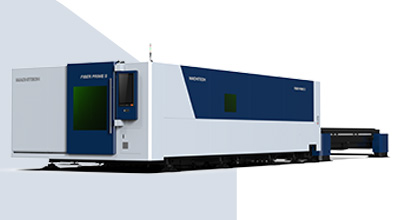
- Non-Compliant Shipping: Some manufacturers ship fiber laser systems without a protective enclosure or "cell." These "open" tables do not meet North American safety standards (ANSI Z136.1).
- The Risk: A fiber laser operates at a wavelength (typically 1070nm) that is invisible to the human eye but can cause permanent blindness instantly through direct or reflected beams.
- The Standard: Top manufacturers provide fully enclosed, light-tight Class 1 laser systems. This ensures that the hazardous Class 4 radiation is contained within the cell, protecting everyone in the shop without the need for specialized laser goggles for every bystander.
3. Facility Engineering & Environmental Controls
Safety is also built into how the machine manages its own environment, particularly regarding air quality and fumes.
- Zoned Downdraft Extraction: Rather than just a general fan, top systems use automated zoned chambers. These chambers open only directly under the torch to capture 99% of fumes, including toxic hexavalent chromium or manganese, and duct them into a HEPA-grade filtration system.
- Hydrogen Mitigation: For manufacturers building water tables, specific agitation systems are integrated to prevent the buildup of hydrogen gas when cutting aluminum, which can otherwise lead to localized explosions.
4. Electrical and Grounding Integrity
A cutting table acts as a massive electrical "sink." Leading manufacturers build their electronics to withstand the high-frequency starts of a plasma arc.
- Dedicated Grounding: Proper systems are engineered with a dedicated copper ground path separate from the shop's electrical neutral. This prevents high-voltage interference from reaching the CNC controller, which is a leading cause of "ghost" errors and electrical fires.
- Arc Shielding: Internal components are shielded in metal cabinets to prevent Electromagnetic Interference (EMI) from affecting other sensitive shop equipment.
5. Safety Is a Culture, Not Just a Rulebook
Ultimately, even the most safely engineered machine requires a strong safety culture. Top manufacturers such as Machitech, support this by providing extensive machine-specific competency training. Adhering to Lockout/Tagout (LOTO) procedures, ensuring the machine is de-energized before any maintenance, remains the gold standard for operational safety.