WHAT ARE THE DIFFERENT TYPES OF PLASMA CUTTERS?
December 5th, 2025
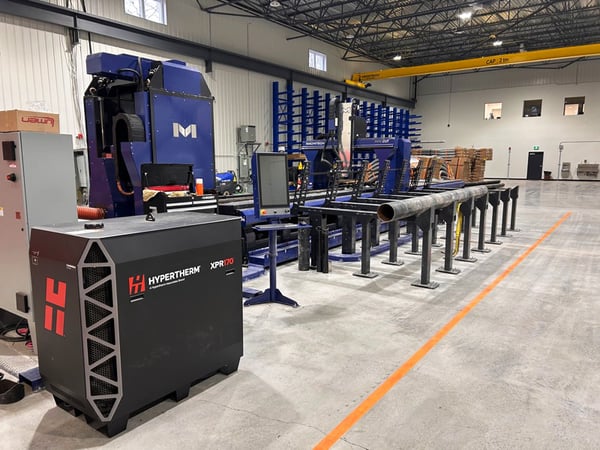
Programming for complex cuts has evolved significantly with the introduction of high definition plasma sources like the Hypertherm XPR series. In today's fabrication landscape, success is no longer just about basic geometry; it is about leveraging advanced software and integrated machine intelligence to achieve laser like precision on intricate profiles.
The New Standard in Plasma Programming
Modern CNC systems have redefined what is possible with complex shapes. By combining Machitech's robust gantries with X Definition cutting technology, shops can now process fine features that were previously reserved for laser systems.
1. Leverage Integrated CAD/CAM Ecosystems
To achieve precision on complex parts, utilize high level CAD software to build your 3D models. When these are imported into advanced nesting software like Hypertherm Pronest, the system can automatically apply lead ins and lead outs tailored for intricate geometries. This ensures that the start and end of a cut do not leave witness marks on your finished edge.
2. Utilize True Hole and True Bevel Technology
Complex parts often require bolt ready holes or specific weld preparations. Programming for these is now automated through Machitech's integration of Hypertherm technology.
- True Hole: Automatically adjusts timing, arc control and motion settings to produce bolt ready holes with virtually no taper.
- True Bevel: Simplifies the programming of multi axis cuts, allowing the machine to handle complex edge transitions without manual trial and error.
3. Dynamic Height Control and Corner Slowdown
Intricate designs often involve sharp corners and tight radii. Programming for these requires the machine to slow down to maintain accuracy.
- Corner Slowdown: Modern software automatically reduces feed rates in tight turns to prevent the plasma arc from "trailing," which can cause rounded corners or gouging.
- Voltage Sampling THC: Machitech’s Torch Height Control (THC) samples the arc voltage at the start of every cut. This ensures the torch maintains a perfect standoff distance, which is critical for preventing taper on complex profiles.
4. Smart Nesting and Heat Management
When cutting complex parts in high volume, heat buildup can distort the material. Modern programming techniques include:
- Chain Cutting: Minimizing pierces by linking parts together, which reduces consumable wear.
- Heat Displacement: Strategically sequencing cuts across the plate to allow sections to cool, maintaining the dimensional integrity of the final product.
5. Proactive Maintenance Alerts
In a modern shop, the machine itself assists in the process. Machitech systems provide real time feedback on consumable life and motion performance. Programming with a "preventative" mindset ensures that your complex cuts are never compromised by a worn nozzle or a loose drive belt.