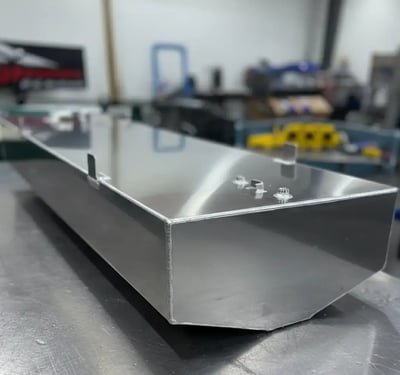


WHY ALUMINUM IS THE GOLD STANDARD FOR MARINE TANKS
February 5th, 2026
When you’re miles offshore, your fuel tank isn't just a container, it’s a critical safety component. While cars and planes have their own challenges, marine vessels live in one of the harshest environments on Earth: saltwater. For decades, shipbuilders and custom fabricators have turned to aluminum as the primary choice for fuel storage. Here’s why it remains the superior option for the marine industry in 2026.
1. The "Self-Healing" Defense Against Corrosion
The biggest threat to any metal at sea is oxidation (rust). While steel can flake away until a tank leaks, aluminum has a unique "superpower." The moment aluminum is exposed to air, it forms a microscopic, diamond-hard layer called aluminum oxide.
This layer acts as a permanent shield, sealing the underlying metal from salt and moisture. For added protection in damp bilge environments, many fabricators also apply specialized polymer coatings to prevent "pitting" where the tank touches the hull.
2. High Strength, Low Weight
In shipbuilding, every pound matters. Aluminum is roughly one-third the weight of steel, yet by using the right alloys, it provides the structural integrity needed to withstand the "sloshing" forces of hundreds of gallons of fuel in heavy seas.
By reducing the weight of the fuel tanks, shipbuilders can:
- Increase the vessel's top speed.
- Improve fuel efficiency.
- Lower the ship’s center of gravity for better stability.
3. Precision Fabrication with CNC Technology
Marine fuel tanks are rarely simple boxes. Because every hull design is unique, tanks must be shaped to fit into tight, irregular "voids" within the ship’s structure.
This is where aluminum shines in the fabrication shop. Using plasma or fiber laser cutting, fabricators can achieve high-precision cuts on "marine grade" aluminum. Despite being strong, aluminum is "malleable" enough to be bent and welded into complex geometries without cracking, ensuring a perfect fit for any vessel.
4. Meeting the "Marine Grade" Standard (ABYC)
Not all aluminum is created equal. For a fuel tank to be safe and legal, it must meet strict standards set by the American Boat and Yacht Council (ABYC). When fabricating or ordering a tank, ensure it meets these critical specs:
- The Right Alloy: Only use 5052, 5083, or 5086 grades. These contain magnesium, which makes them specifically resistant to saltwater.
- The Right Thickness: * Small Tanks: Minimum 0.090 inches.
- Large Tanks: Between 0.125 and 0.250 inches depending on volume.
- The Pressure Test: Every finished tank must be pressure-tested to ensure the welds are airtight before installation.
5. Using Fiber Lasers for Clean Precise Cuts
In modern shops Fiber Lasers are the go to tool for cutting out aluminum tank parts because they are incredibly fast and accurate. The laser uses a concentrated beam of light to slice through the metal so quickly that it does not overheat the surrounding area. This helps the aluminum keep its natural strength and rust resistance. To get the best results fabricators use Nitrogen gas during the cutting process. This keeps the edges shiny and clean so they are much easier to weld together without any hidden air bubbles or weak spots. This high tech approach means every piece from the outer walls to the internal dividers fits together perfectly. It creates a tough leak proof tank that you can rely on when you are out on the water.