
WHAT GAS SHOULD YOU USE WITH A PLASMA CUTTER?
February 5th, 2026
Plasma cutting remains a cornerstone of modern metal fabrication, but as we move through 2026, the technology has evolved. While basic air plasma is still common for manual work, industrial-grade systems, like the Hypertherm™ XPR series, now use sophisticated "X-Definition" processes.
At the heart of this process is an ionized gas that makes the cut possible. The gas you choose depends on the material, thickness, and the specific gas console technology your machine utilizes.
How Modern Plasma Cutting Works
In a modern XPR system, gas isn’t just a conductor; it’s a precision tool. The gas is injected at high pressure through a narrow nozzle, where an electric arc ionizes it into plasma (reaching temperatures up to 25,000 °C). The Gas Consoles automatically mix these gases in real-time to optimize the arc for the specific alloy you are cutting.
The Standard Gases: Characteristics & Uses
| Gas / Mixture | Advantages | Disadvantages | Typical Applications |
| Oxygen (O₂) | Fastest cutting on mild steel; leaves a paint-ready edge. | High consumable wear; not for stainless or aluminum. | Mild steel (standard in Core/VDC consoles). |
| Nitrogen (N₂) | Excellent for non-ferrous metals; very cost-effective. | Can leave a slight nitrided edge that may affect welding. | Stainless steel and Aluminum, line purging |
| F5 (95% N₂, 5% H₂) | Produces a very shiny, silver cut edge on stainless. | Limited to thinner gauges; requires hydrogen safety protocols. | High-end stainless steel aesthetics. |
| H35 (35% H₂, 65% Ar) | Deep penetration for extremely thick materials. | Higher cost; requires VWI or Optimix console. | Thick stainless (> 20mm) and Aluminum. |
| Compressed Air | Most affordable and versatile for general shop work. | Higher oxidation on the cut edge; slower speeds. | General fabrication and maintenance. |
The 2026 Standard: XPR Gas Console Options
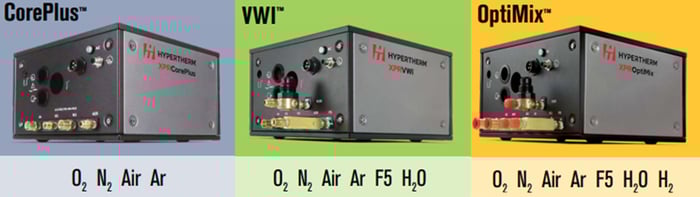
If you are operating a newer XPR170, XPR300 or XPR460, your gas options are determined by your console type. In 2026, these consoles manage "True Hole", gas mixing and "Vented Water Injection" (VWI) technologies automatically.
1. The Core/CorePlus Consoles
The entry-level industrial standard. It utilizes Oxygen, Nitrogen, Argon (CorePlus only) and Air. It is the go-to for shops primarily cutting mild steel and standard stainless. It provides excellent "X-Definition" quality without the complexity of hydrogen-based mixtures.
2. The VWI (Vented Water Injection) Console
The VWI console expands your capabilities by adding F5 gas. This is essential for 2026 fabricators who need a "mirror-like" finish on stainless steel or need to cut very thick non-ferrous plates.
3. The OptiMix Console
The top-tier 2026 gas technology. Instead of using pre-mixed bottles, the OptiMix blends three gases (Ar, H₂, N₂) on the fly. This allows the system to adjust the gas chemistry during the cut for different thicknesses, resulting in the lowest cost-per-cut and the highest precision available in the industry today.
Pro-Tips for 2026
- Vented Water Injection (VWI): If cutting aluminum, using Nitrogen as the plasma gas combined with a water shield (enabled by XPR VWI/OptiMix) results in a squared edge with virtually no dross.
- Sustainability: Modern gas consoles are now optimized to reduce gas "waste" during pre-flow and post-flow, significantly lowering the carbon footprint of your nitrogen and oxygen usage.
- Auto-Calibration: In 2026, your CNC controller should automatically suggest the gas based on the material selected in the CAD/CAM software. If the cut chart suggests F5 for stainless but you only have the Core Console, it will automatically "downgrade" the parameters to Nitrogen to ensure the cut still finishes successfully.
Bottom Line
Choosing the right gas in 2026 is no longer just about the bottle; it’s about the Console. For mild steel, Oxygen remains the king. For high-grade stainless and aluminum, the move toward VWI and OptiMix consoles using water shield and/or Argon/Hydrogen blends is the gold standard for achieving "laser like" quality at plasma speeds.